Brass vs. Stainless Steel Faucets: What Importers Should Know
If you import bathroom faucets, the material question arrives sooner or later: brass or stainless steel? Both have legitimate places in a sourcing program, and both are widely misrepresented in sales brochures. This guide explains how the two materials differ in manufacturing, compliance, finish quality and cost, so you can match the material to your market instead of to a supplier's pitch.
Why the Material Decision Matters for Importers
The body material of a faucet determines far more than durability. It affects which finishes can be applied, how the faucet behaves in hard water, whether it can be certified for markets with lead rules, what it costs to machine into complex shapes, and how heavy each carton is at the freight terminal. A wrong choice shows up later as warranty claims, failed inspections, or a product that cannot legally be sold in your target state or country.
Brass Faucets: The Industry Standard
Brass, a copper-zinc alloy, has been the default faucet material for decades for good reasons. It casts beautifully, machines cleanly into the complex internal waterways a mixer requires, accepts electroplated finishes better than almost any other metal, and naturally resists dezincification when the right grade is used.
Grades you will actually see in quotations
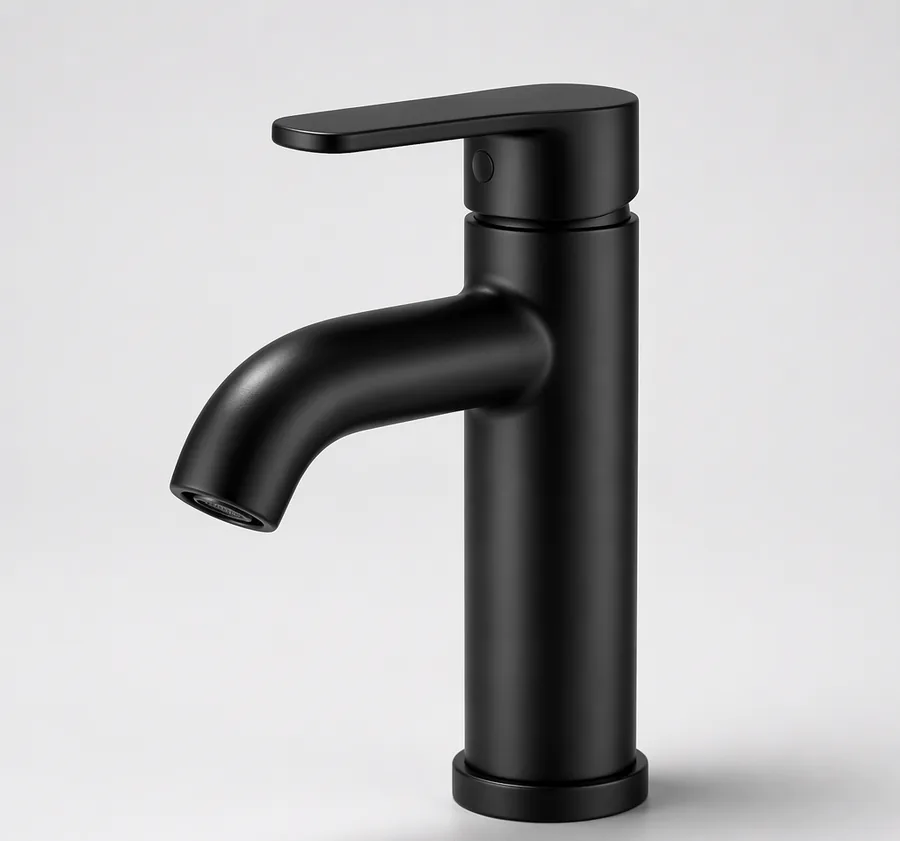
- H59 brass – approximately 59% copper. The workhorse grade for faucet bodies: excellent castability and machinability at a competitive cost. Most quality Chinese faucets, including our AquaLine basin faucet, use H59 bodies.
- H62 brass – approximately 62% copper. Slightly better corrosion resistance and ductility; common for premium lines and thin-wall castings.
- Lead-free / low-lead brass – formulations such as C46500 or bismuth brass that meet the US Safe Drinking Water Act "lead free" definition (weighted average of 0.25% or less on wetted surfaces). Required for drinking-water products in the US and Canada.
Strengths and limits
Brass is the easiest material to plate, which is why virtually every chrome, matte black, brushed gold or gunmetal finish collection on the market starts from a brass body. Its weakness is cost volatility (copper prices move) and the lead content question in traditional grades, which is manageable but must be specified explicitly for North America.
Stainless Steel Faucets: The Compliance-Friendly Challenger
Stainless steel faucets, almost always SUS304 (18/8), have grown steadily in markets with strict lead regulations and among buyers who market "no plating, no peeling" as a selling point. The body is typically assembled from machined, drawn or cast stainless components welded together, then brushed or polished mechanically instead of electroplated.
Strengths
- Inherently lead-free – no alloyed lead at all, which simplifies compliance with US, Canadian and EU drinking-water rules and is a clean marketing claim.
- No coating to fail – the brushed surface is the metal itself, so there is no plating to peel or blister. Scratches can often be re-brushed.
- Excellent corrosion resistance – SUS304 handles chlorinated water and coastal air well, which is why stainless dominates in coastal and tropical markets.
Limits
- Harder to form – stainless work-hardens, so complex curved spouts cost more to produce; the design language skews modern and tubular.
- Finish options are narrower – true stainless color plus PVD coatings (black, gold, gunmetal) work well, but classic electroplated chrome looks are not the natural output.
- Price – quality SUS304 bodies usually cost more than equivalent H59 brass.
Head-to-Head Comparison for Buyers
| Factor | H59/H62 Brass | SUS304 Stainless |
|---|---|---|
| Castability of complex shapes | Excellent | Limited; mostly fabricated |
| Finish variety (plating) | Widest: chrome, black, gold, nickel, gunmetal | Brushed natural + PVD colors |
| Lead compliance (US/CA) | Needs lead-free grade specified | Inherently compliant |
| Corrosion in coastal air | Good with quality plating | Excellent |
| Repair of surface damage | Re-plating not field-practical | Can often be re-brushed |
| Typical cost | Lower | Higher |
What to Verify with Any Supplier
- Material certificates. Ask for the alloy grade in writing (H59, H62, SUS304) and a material test report with the batch. "Brass" without a grade is a red flag.
- Lead content documentation for North America. If you sell into the US or Canada, specify lead-free wetted components and confirm the factory can support cUPC-related evaluation of the configuration you are buying.
- Wall thickness and weight. Faucet weight is a quick proxy for material honesty; ask for the net weight per unit and compare across quotations.
- Salt-spray hours by finish. For plated brass, ask for ASS or CASS hours per finish; 48 hours is a serious claim, 24 hours is entry level. For stainless, ask what grade the weld zones are passivated to.
- Where stainless is still used in a brass faucet. Even brass programs use SUS304 or SUS201 for shower rails and heads; mixing is normal and not a defect.
Our Recommendation by Buyer Type
Retail and e-commerce programs usually maximize sell-through with brass bodies in trend finishes; matte black and brushed gold convert best and require plating anyway, which makes brass the natural base. Coastal, tropical and regulation-sensitive markets justify SUS304 lines, especially for shower components and accessories such as robe hooks and towel bars where stainless is the standard anyway. Project buyers should specify per location: brass plated faucets for rooms, stainless for wet zones and outdoor-adjacent areas.
At BathVela we manufacture both: H59 brass faucet bodies across our basin faucet and shower faucet ranges, and SUS304 across hooks, shelves and accessories, with material test reports available for every batch. Tell us your target markets and we will recommend the material configuration that passes your compliance requirements at the best landed cost.